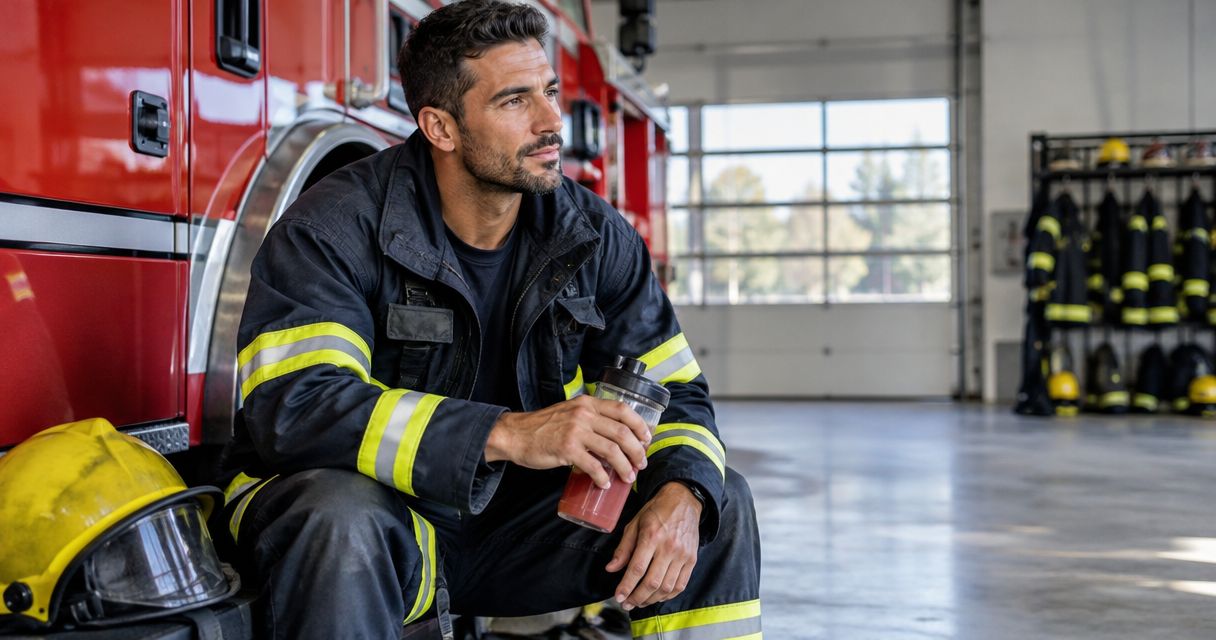
Firefighters’ energy supplementation is the use of dietary supplements alongside food, hydration, and recovery habits with the aim of supporting everyday energy. This 2026 guide to energy supplements for firefighters puts duty readiness first: interrupted sleep, heat exposure, and unpredictable calls make product safety more important than an energy promise.
- Energy supplements for firefighters cannot replace sleep, incident rehabilitation, or medical evaluation of persistent fatigue.
- Sol Nutrition offers herbal options for clinician-reviewed wellness routines, not emergency alertness or firefighter performance guarantees.
- Compare complete labels, medication interactions, and department requirements before choosing an energy or vitality supplement.
- Keep sleep-support products separate from on-call readiness decisions; natural does not mean non-impairing.
Why energy support matters for firefighters
A firefighter’s energy plan must work around interrupted meals, protective equipment, physical exertion, and the possibility of another call. Feeling more awake is not the same as being adequately rested or ready for hazardous work.
Start with the cause of fatigue, not the strongest-sounding supplement. For broader scheduling context, read the guide to energy support for night-shift workers. Firefighters also need to account for emergency driving, incident rehabilitation, and their department’s fitness-for-duty requirements.
For your 2026 routine, separate everyday wellness from operational readiness. A dietary supplement is not a substitute for reporting fatigue, taking an authorized recovery break, or getting medical attention when something feels wrong.
How to build a firefighter energy routine in 2026
1. Map fatigue before changing your routine
Use a notebook or phone note to record when low energy appears. Begin with a 7-day log, extending it if that period does not include both duty and recovery days. This is a practical starting point, not a diagnostic test.
Record the circumstances rather than assigning yourself a condition. Sleepiness after repeated overnight calls needs a different conversation from weakness during exertion or fatigue that continues despite recovery time.
Take the record to your occupational health clinician or primary care professional if fatigue persists, worsens, or affects safe work. Do not use supplements to postpone that discussion.
- Record sleep opportunities and interruptions.
- Note meals, fluids, caffeine, and alcohol.
- Describe fatigue as sleepiness, weakness, or difficulty concentrating.
- Mark whether symptoms occur on duty, off duty, or both.
- List medicines and supplements alongside their timing.
2. Protect meals, hydration, and recovery opportunities
Build the manual foundation first: pack food, make fluids accessible, and use authorized rest opportunities. Supplements do not provide the meal you missed or restore the sleep interrupted by calls.
Choose foods you tolerate during your workday. A packed meal with a carbohydrate source, protein, and other familiar foods is a more useful starting point than replacing lunch with an energy product. Keep a backup snack for calls that disrupt the station meal.
Hydration during hot, strenuous work belongs within your department’s incident rehabilitation procedures. Avoid creating a rigid fluid or electrolyte schedule from a supplement article; needs depend on working conditions and your health.
- Pack a meal you can store and eat safely.
- Keep a familiar backup snack accessible.
- Follow department hydration and rehabilitation procedures.
- Protect off-duty sleep from avoidable interruptions.
- Tell the appropriate supervisor when fatigue compromises readiness.
3. Define the supplement question before shopping
Ask what you actually want to change. Are you comparing caffeine-free herbal products, investigating persistent fatigue, or trying to recover after disrupted sleep? Those are different decisions, and a product name cannot resolve them.
Sol Nutrition energy supplements are best for adults comparing herbal wellness options with a clinician, not firefighters seeking immediate operational alertness. The brand’s founder, Dr. Jing Liu, brings more than 30 years of clinical experience in Traditional Chinese Acupuncture and Herbal Medicine. That background distinguishes the brand’s approach; it does not establish a finished product’s effectiveness or safety for firefighting.
For a caffeine-free shopping category, GOGO ENERGY™️ is described as a caffeine-free herbal energy supplement. Best for: adults who want to discuss a caffeine-free option with a clinician. Its limitation is equally important: that description does not establish improved endurance, reaction time, or on-duty safety.
ADRENAL SUPPORT™️ is described as an herbal supplement for stress, energy, and daily vitality. Best for: adults discussing general wellness goals with a clinician. The name does not diagnose an adrenal condition or show that the product corrects one.
- Write down the wellness goal in plain language.
- Separate caffeine preference from a safety assessment.
- Ask what evidence supports the exact finished formula.
- Reject promises about emergency performance or guaranteed results.
4. Review the complete label with a qualified professional
Bring the current Supplement Facts panel, directions, and warnings to a pharmacist or clinician. A short product description is not enough to assess ingredients, amounts, interactions, or suitability for safety-sensitive work.
Include everything you take, even occasional medicines and products from a gym bag or station locker. Herbal ingredients can interact with medicines, and combining products can duplicate ingredients without making that obvious from the front labels.
Ask about your actual duties: emergency driving, strenuous work, heat exposure, and being recalled unexpectedly. Discuss pregnancy, breastfeeding, planned surgery, and relevant health conditions when applicable. Do not change prescribed treatment to make room for a supplement.
- Share complete labels rather than product names alone.
- List prescriptions, over-the-counter medicines, and other supplements.
- Ask about overlapping ingredients and known interactions.
- Review warnings relevant to your health and duties.
- Follow department supplement and fitness-for-duty requirements.
5. Make any approved change away from safety-sensitive work
If your clinician considers a supplement appropriate, ask when and how to introduce it without creating a duty risk. Do not make the first use of an unfamiliar product part of a shift, drill, emergency response, or drive home.
Use 1 product change at a time as a tracking rule. It helps you describe what changed, but it does not prove that a product caused a benefit or reaction. Follow the label and your clinician’s advice rather than increasing the amount because a shift feels demanding.
Sol Nutrition offers the following products for comparison, not as a firefighter performance protocol. The cards identify the exact options discussed above; neither product should be treated as a rescue measure for exhaustion.
- Agree on timing with your clinician before starting.
- Avoid first use before driving or hazardous work.
- Do not combine new products to chase a stronger effect.
- Record unwanted effects and stop use if they occur.
- Seek medical help for serious or concerning symptoms.


6. Reassess energy without confusing it with readiness
Compare your notes across 3 duty cycles as an organizational checkpoint, not an expected results timeline. Review sleep opportunities, meals, workload, and symptoms together. A quieter shift is not evidence that a supplement improved recovery.
Keep operational decisions separate from your personal impression of a product. Feeling energized does not establish that you can safely drive, enter a hazardous environment, or return to strenuous work after an incident.
Persistent fatigue deserves medical evaluation rather than a larger supplement stack. Chest pain, fainting, confusion, or severe shortness of breath require urgent medical attention, not a different energy formula.
- Review the log with your clinician when symptoms continue.
- Track unwanted effects as carefully as perceived benefits.
- Note changes in workload and sleep before drawing conclusions.
- Follow established procedures for fatigue and incident recovery.
- Reconsider whether the supplement has a clear role at all.
Compare your energy-support options
Use this 2026 comparison to match the next action to the problem. No supplement option below establishes fitness for duty. The best choice can be a better-packed meal, a recovery opportunity, or medical evaluation rather than a purchase.
| Option | Best for | Main advantage | Key limitation |
|---|---|---|---|
| Meal and snack planning | Firefighters whose calls interrupt eating | Addresses access to food during unpredictable workdays | Does not correct sleep loss or explain persistent fatigue |
| Department rehabilitation and hydration procedures | Firefighters recovering from strenuous incidents | Places recovery within established operational procedures | Requires attention to conditions and individual needs |
| Sleep and fatigue-management planning | Firefighters with interrupted recovery opportunities | Addresses the opportunity to rest | Calls and staffing demands can disrupt the plan |
| GOGO ENERGY™️ | Adults comparing caffeine-free herbal energy options with a clinician | Offers a clearly identified caffeine-free category | Caffeine-free does not establish non-impairment or firefighter performance benefits |
| ADRENAL SUPPORT™️ | Adults discussing stress, energy, and vitality wellness goals | Provides another herbal option for label review | Product naming does not establish an adrenal diagnosis or treatment |
| Clinician-directed evaluation | Firefighters with persistent, worsening, or unexplained fatigue | Assesses causes instead of guessing from symptoms | Requires an individualized assessment, not self-selection from a shelf |
You do not need to try every option. Choose the action that addresses the concern you have documented, and avoid treating supplements as the default next step after a difficult shift.
Common mistakes firefighters make with energy supplements
Treating an energy product as permission to push through
A capsule cannot authorize continued work when fatigue affects judgment or coordination. Follow your department’s reporting and rehabilitation procedures rather than using a product to override warning signs.
Better move: make the readiness decision before the shopping decision. If you are not safe to drive or work, address that directly.
Assuming caffeine-free means safe for any shift
Caffeine content answers only one label question. It does not settle interactions, individual reactions, or suitability for emergency work, and herbal products still require a complete safety review.
Better move: ask a pharmacist or clinician about the entire formula and your duties. Do not infer non-impairment from natural or caffeine-free wording.
Combining daytime and sleep products around unpredictable calls
Being able to sleep at the station is not the same as having protected off-duty recovery time. Products intended for sleep can conflict with the need to wake, drive, and respond safely.
Better move: discuss any sleep-support product with your clinician and department before use. Do not assume a scheduled rest period removes the possibility of recall.
Choosing by a body-system name instead of evidence
Adrenal, thyroid, hormone, and vitality language can sound like an explanation for fatigue. A product label is not a diagnosis, and persistent symptoms should not become a reason to assemble several formulas.
Better move: describe your symptoms without diagnosing yourself. Ask what evaluation is appropriate and whether any supplement is justified.
FAQ
What are the best energy supplements for firefighters?
No single energy supplement is best for all firefighters. Start with sleep opportunities, food, hydration, and evaluation of persistent fatigue, then review any proposed supplement against your health, medicines, and duty requirements.
Are caffeine-free energy supplements safe to take on duty?
Caffeine-free labeling alone does not establish safety for on-duty use. Review the complete formula with a clinician or pharmacist and follow your department’s requirements for safety-sensitive work.
Is Sol Nutrition GOGO ENERGY proven to improve firefighter performance?
The product information provided does not establish improved firefighter performance. GOGO ENERGY is described as a caffeine-free herbal energy supplement, which is not evidence of improved reaction time, endurance, or operational readiness.
Can an adrenal support supplement fix fatigue after a long shift?
An adrenal support product name does not establish that it fixes post-shift fatigue. Persistent or unexplained fatigue needs medical assessment rather than a self-diagnosis based on supplement marketing.
Can firefighters take sleep supplements while on call?
Firefighters should not assume a sleep supplement is compatible with on-call duties. Discuss the exact product, emergency driving, recall requirements, and potential impairment with a clinician and the department before use.
How long should firefighters try an energy supplement?
There is no universal trial period for energy supplements. Follow the exact product directions and individualized clinical advice, and do not wait through worsening fatigue or unwanted effects to reach an arbitrary deadline.
Can firefighters combine several herbal energy products?
Do not combine herbal energy products without a review of their complete labels and your medicines. Overlapping ingredients and interactions require assessment even when each product is sold for a different wellness goal.
One last thing
For your 2026 routine, bring a photograph of each complete supplement label to your next occupational health visit. The useful question is not just whether a product supports energy; it is whether that exact formula belongs in your routine given your medicines, sleep opportunities, and safety-sensitive duties.
Sol Nutrition’s founder experience offers context for its herbal approach, not a shortcut around that review. The strongest energy plan is one that helps you recognize when you need food, rest, rehabilitation, or medical care instead of another product.
Dietary supplements are not intended to diagnose, treat, cure, or prevent any disease. This article provides general education, not individualized medical advice. Consult a qualified healthcare professional before starting a supplement, especially if you take medicines, have a health condition, are pregnant or breastfeeding, or perform safety-sensitive work.